Hire a Professional Video Production Company: 2026 Guide

Table of Contents
What a Professional Video Production Company Actually Delivers
Video Production Company Portfolio and Case Studies: How to Evaluate Real Work
What to Look For Beyond the Highlight Reel
Questions to Ask a Video Production Company Before You Sign
The End-to-End Hiring Workflow
Rights, Usage, and Contract Terms You Need in Writing
What a Strong Video Production Proposal Includes
Video Production Timeline: From Kickoff to Final Delivery
Pricing Models and Budget Planning for Video Production Services
What Actually Drives the Price
Typical Cost Ranges by Video Type
How to Build a Budget That Survives the Shoot
How to Measure Video Performance and Business Outcomes
Conclusion: Your Next Steps to Hire a Professional Video Production Company
Frequently Asked Questions
Last Updated: October 15, 2026
What a Professional Video Production Company Actually Delivers
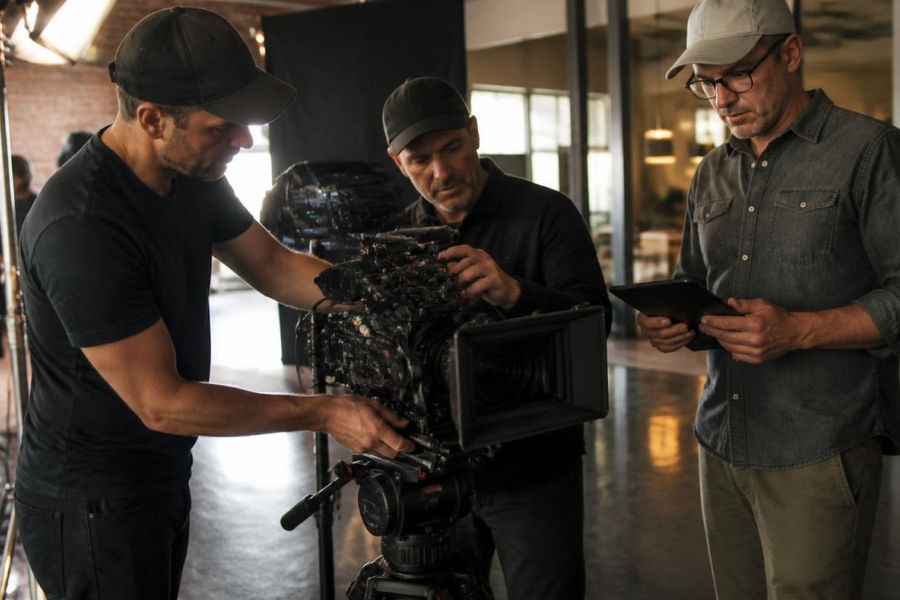
A professional video production company is a full-service partner handling creative strategy, pre-production, filming, and post-production under one roof, delivering finished assets built for specific business goals. At Sharpe Video Productions, crew, equipment, edit, and delivery sit with one accountable team.
The deliverable is never just "a video." A strong partner delivers a creative strategy tied to your marketing objectives, a scoped set of deliverables, and a finished asset ready for broadcast, social media content, and internal channels.
When you hire a professional video production company in 2026, you're buying a process, not a shoot day. That process includes:
Pre-production: scriptwriting, storyboards, location scouting, and scheduling
Production: production crew, equipment, lighting, and on-set direction
Post-production: video editing, motion graphics, animation, sound design, and color
Key Takeaway The clearest sign of a full-service production company is a single point of contact who owns the project from the project brief through final delivery. If you're coordinating four separate vendors, you're not hiring a production partner; you're project-managing one yourself.
Video Production Company Portfolio and Case Studies: How to Evaluate Real Work
A portfolio shows what a company can do when everything goes right. Case studies show what happens when it doesn't. Evaluate both, and weight the case studies more heavily.
What to Look For Beyond the Highlight Reel
Start by asking for work in your category. A reel of cinematic wedding films tells you little about whether a team can produce a corporate training video that holds attention or a commercial that moves a product. Look for experience matching your use case: commercial and brand-film production, event videography, aerial coverage, or training content.
Then dig into the process behind the work:
Client testimonials with names and roles, not anonymous praise
A case study that states the brief, the approach, and the outcome
Raw or unedited footage on request, which reveals how a team handles uncontrolled conditions
If a company can't show a similar completed project, that's not automatically disqualifying, but ask harder questions about how they'd approach yours.
Pro Tip Ask to see a project that went sideways. How a production company talks about a reshoot, a weather delay, or a client change of direction tells you more about working with them than any polished reel.
Questions to Ask a Video Production Company Before You Sign
Ask about scope, rights, timeline, and money before you sign anything. The answers separate a production partner from a vendor who disappears after the shoot. Put these questions in writing:
Question | What You're Really Testing |
Who is my single point of contact? | Whether you'll chase multiple people for updates |
What's included in the scope of work? | Whether editing, revisions, and delivery are extra |
How many revision rounds are included? | Whether changes trigger surprise invoices |
Who owns the footage and final cut? | Whether you can reuse the video freely |
What's the production timeline? | Whether the deadline is realistic |
How do you handle weather or schedule changes? | Whether there's a contingency plan |
Are you insured and certified for drone work? | Whether aerial footage creates legal exposure |
That last question matters more than most buyers realize. Commercial drone work in the U.S. requires FAA Part 107 certification, and an uncertified operator puts your project at legal risk. Sharpe Video Productions is Part 107 certified for aerial drone operations.
The End-to-End Hiring Workflow
A repeatable process protects your budget and deadline. Here's the workflow we recommend, from brief to final delivery.
Step 2, Shortlist three to five vendors. Look for demonstrated work in your category, not just a polished reel.
Step 3, Send the same RFP to every vendor. One document makes proposals comparable. A simple RFP includes:
Project background and objective
Deliverables list with formats and runtimes
Distribution channels and usage term
Criterion | Weight | What to Look For |
Relevant portfolio and case studies | 25% | Work in your category with stated outcomes |
Creative approach and strategy | 20% | A response tailored to your brief, not a template |
Scope clarity and deliverables | 15% | Explicit list of what's included and excluded |
Pricing transparency | 15% | Line-item costs, not a single lump sum |
Timeline and contingency plan | 10% | Realistic schedule with review windows built in |
Rights, licensing, and contract terms | 10% | Ownership, usage, term, and territory in writing |
References and communication | 5% | Responsive, named contacts who vouch for them |
Step 6, Negotiate scope, not just price. If a bid is over budget, cut deliverables or versions rather than squeezing the crew or schedule.
Pro Tip Send the same brief and the same RFP to every vendor. When proposals arrive in a common format, comparing them takes an afternoon instead of a week, and the weakest bid becomes obvious.
Rights, Usage, and Contract Terms You Need in Writing
Usage rights decide where and how long you can run a video. Get these terms in the contract, not a verbal promise:
Ownership: who holds copyright to raw footage and the final edit
Usage scope: broadcast, paid social, web, and internal use, listed explicitly
Term: how long the license runs and what renewal looks like
U.S. Copyright Office guidance on works made for hire is worth reading before you sign, because the default rules may not match what you assume you're buying.
What a Strong Video Production Proposal Includes
A strong proposal answers three questions: what you're getting, when, and what it costs. If any is vague, the project will be too.
Every complete proposal includes a project brief restated in the vendor's own words, a scope of work, a deliverables list, a production timeline, a pricing model, and contract terms. A proposal that skips the deliverables list is a red flag, because "a video" can mean anything from a 15-second social cut to a 30-minute training module.
Video Production Timeline: From Kickoff to Final Delivery
Most projects move through four phases: pre-production, production, post-production, and delivery. The timeline depends on complexity, but the sequence rarely changes.
Phase | What Happens | Typical Duration |
Pre-production | Scriptwriting, planning, location scouting, scheduling | 1-3 weeks |
Production | Filming on location or in studio | 1-3 days |
Post-production | Video editing, motion graphics, sound, color | 2-4 weeks |
Delivery | Revisions, final exports, distribution formats | 3-7 days |
Turnaround compresses when scope is tight and stretches when approvals stall. The biggest delay we see isn't filming; it's a client who needs three weeks to review a rough cut. Build review time into your calendar before blaming the timeline.
Watch Out Booking a shoot before the script is locked is the most expensive mistake in video production. Every change after filming means a reshoot, and reshoots cost far more than an extra week of planning.
Pricing Models and Budget Planning for Video Production Services
Video production pricing depends on scope, crew size, shoot days, animation and motion graphics, travel, and how many finished versions you need. There's no honest flat rate, and any vendor quoting one without asking about your project is guessing.
Pricing models include:
Project-based: a fixed fee for a defined scope of work and deliverables
Day rate: a set cost per filming day, with post-production billed separately
Retainer: a monthly fee for ongoing content, common for social media content and event videography
What Actually Drives the Price
Two projects with the same runtime can differ in cost by an order of magnitude. The biggest variables:
Crew size and roles: a two-person documentary crew costs far less per day than a 12-person commercial unit with a director, DP, gaffer, grip, art department, and hair/makeup.
Shoot days: each additional day adds crew, equipment rental, location, and catering costs, and multiplies post-production footage.
Talent and voiceover: on-camera talent, union rates, and professional VO add line items that amateur projects skip.
Typical Cost Ranges by Video Type
Video Type | Typical Range (USD) | Notes |
Social media short (15-60 sec) | $1,500-$7,500 | Single shoot day, minimal crew, fast turnaround |
Corporate interview / testimonial | $3,000-$15,000 | One or two locations, basic motion graphics |
Brand film / commercial | $15,000-$150,000+ | Multi-day shoot, larger crew, talent, licensing |
Animated explainer | $5,000-$25,000 | Priced per finished minute; script and design heavy |
Training / e-learning module | $8,000-$40,000 | Often includes scripting, LMS-ready exports, captions |
Event coverage | $2,500-$12,000 | Depends on hours, number of cameras, same-day edits |
How to Build a Budget That Survives the Shoot
Budget planning starts with the deliverables list, not the shoot day. Decide how many finished videos you need, where they'll run, and how long they stay current, then ask for a quote against that scope.
A practical approach:
Write the deliverables list first. "One 90-second brand film plus three 15-second social cuts in 9:16 and 1:1" is a scope. "A video" is not.
Separate production from post. Ask for shoot-day costs and post-production costs as distinct line items so you can see where the money goes.
Hold a 10-15% contingency. Weather, reshoots, and scope changes are common; a contingency keeps a small change from becoming a crisis.
Price the versions, not just the hero cut. Platform-specific exports, captions, and language versions are where budgets quietly grow.
Ask what's excluded. Drone work, travel, talent residuals, and music licensing are frequently left out of initial quotes.
Watch Out A quote that is dramatically lower than every other bid is usually missing something, crew, insurance, licensing, or revisions. Ask what's not included before you celebrate the savings.
Because pricing varies so much by project, we quote each job individually rather than publish a rate card. Contact Sharpe Video Productions for current pricing on your specific scope.
How to Measure Video Performance and Business Outcomes
Measure video against the objective you set before production, not view count alone.
Use metrics that map to the goal:
Brand awareness: reach, impressions, and video views
Engagement: watch time and completion rate
Action: click-throughs, form fills, and conversions
Google's guidance on measuring video campaign performance covers how these metrics are tracked across platforms. Set your baseline before launch so you have something to compare against.
The throughline is simple: the brief you write determines what you can measure later. Define success in the project brief, and the reporting writes itself.
Conclusion: Your Next Steps to Hire a Professional Video Production Company
The hardest part of hiring a production partner isn't finding one; it's comparing them fairly.
Sharpe Video Productions brings award-winning commercial production experience, Part 107 certified aerial coverage, and full-service creative direction to every project, from corporate training videos to music videos and brand films.
Get started with Sharpe Video Productions and turn your next project brief into finished video that earns its budget.
Frequently Asked Questions
How do I choose a professional video production company?
Start by defining your project goals, audience, and budget range. Then shortlist three to five video production companies whose portfolios match your content type, whether that is corporate video, commercial video, brand film, or social media content. Request proposals from each, compare their creative strategy, video production timeline, deliverables, and pricing model side by side. Ask for client testimonials and check whether they carry relevant certifications, such as Part 107 for drone work. The company that asks the most thoughtful questions about your marketing objectives is often the strongest partner.
What should I look for when hiring a video production company?
Look for industry experience in your specific use case, a clear scope of work, and a portfolio that shows finished projects rather than just demo reels. Confirm they handle pre-production, production, and post-production in-house or through trusted partners. Check their equipment list, whether they do location scouting, and how many revision rounds are included. Also verify insurance and any required certifications. A video production agency that explains its process transparently and provides a detailed video production proposal is a safer hire than one that only promises a great final cut.
What questions should I ask a video production company before hiring them?
Ask who will be your main point of contact, how many revision rounds are included, and what happens if weather or scheduling delays a shoot day. Request details on usage rights: can you run the video on TV, paid social, and your website indefinitely, or is there a licensing window? Ask about turnaround time for editing and whether they offer distribution-ready formats for different platforms. Also ask what footage and project files you receive at the end. These questions to ask a video production company will surface hidden costs and prevent surprises after the contract is signed.
How much does it cost to hire a video production company?
Pricing depends on the scope, number of shoot days, crew size, animation or motion graphics needs, and delivery timeline. A simple social media content package costs less than a full commercial video with scriptwriting, actors, and location scouting. Because every project is different, request a custom quote based on your specific brief. Sharpe Video Productions provides fairly priced services and will walk you through a detailed estimate once your project scope is defined.
What should a video production proposal include?
A complete video production proposal should include a project summary, creative strategy, scope of work, production timeline with milestones, deliverables list, and a detailed budget breakdown. It should also specify the number of revision rounds, usage rights, and payment schedule. Look for a section on pre-production tasks such as scriptwriting, storyboarding, and location scouting. If the proposal does not clearly state what is included and what costs extra, ask for clarification before signing. A transparent proposal protects both you and the production partner.
How long does professional video production take?
A typical corporate video or commercial video takes four to eight weeks from kickoff to final delivery, depending on complexity. Pre-production, including scriptwriting and location scouting, usually takes one to two weeks. Filming can be one to three days. Post-production, including video editing, color grading, and motion graphics, takes two to four weeks. Social media content with a simpler scope can turn around faster. Always confirm the video production timeline in writing and ask about expedited options if you have a fixed launch date.
What is the difference between a videographer and a video production company?
A videographer typically handles filming and basic editing alone, which suits simple event videography or single-camera shoots. A video production company offers full-service production: creative strategy, scriptwriting, casting, location scouting, a production crew, professional equipment, and post-production with animation and motion graphics. For corporate video, commercial video, or brand film projects that need storytelling and polish, a full-service production partner delivers a more consistent result. The right choice depends on your project's complexity and your marketing objectives.
Get Started Today

Comments